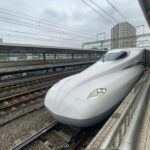


Beyond the Everyday Commute: How to Track Down Japan’s Ultra-Rare Special Trains

Crack the Code: The Hunt for Japan’s Seasonal Rail Gems
If you have ever stood on a platform in Japan and watched a vibrant, retro train roar past completely unannounced, you know the thrill of spotting a rare rolling stock movement. These aren’t your everyday commuter fleets; they are special, seasonal limited express trains (known as rinji ressha or 臨時列車) that only operate on select weekends or holidays. Because they don’t appear on standard daily station timetables, catching them can feel like searching for a needle in a haystack.
Fortunately, you don’t have to rely on pure luck. With the right toolkit, anyone can track down these elusive operations like a seasoned Japanese railfan. Here is exactly how to uncover the secret schedules of Japan’s finest special trains.
The Ultimate Railfan Weapon: Why Tetsudo.com is Your Best Friend
When it comes to sniffing out irregular train operations, there is one undisputed heavyweight champion: Tetsudo.com (鉄道コム). This premier Japanese railway hub is an absolute goldmine for tracking special events, train retirements, debut runs, and unique limited express schedules.
The website regularly posts comprehensive updates on exactly what special train is operating, where it is headed, and when it will be on the tracks. It is the exact secret weapon used to catch legendary runs like the JNR-colored E653 series.
How to Navigate Tetsudo.com in Your Own Language
Don’t speak Japanese? Don’t let that stop you! The beauty of modern technology means this insider data is fully accessible to global railfans.
- Head over to Tetsudo.com.
- Right-click anywhere on the page and select “Translate to [Your Language]” via Google Translate, Safari, or your preferred browser extension.
- Head directly to the “Event Information” (イベント情報) or “Railway News” sections.
Suddenly, complex Japanese railway timetables will transform into perfectly readable dates, train names, and operating lines!

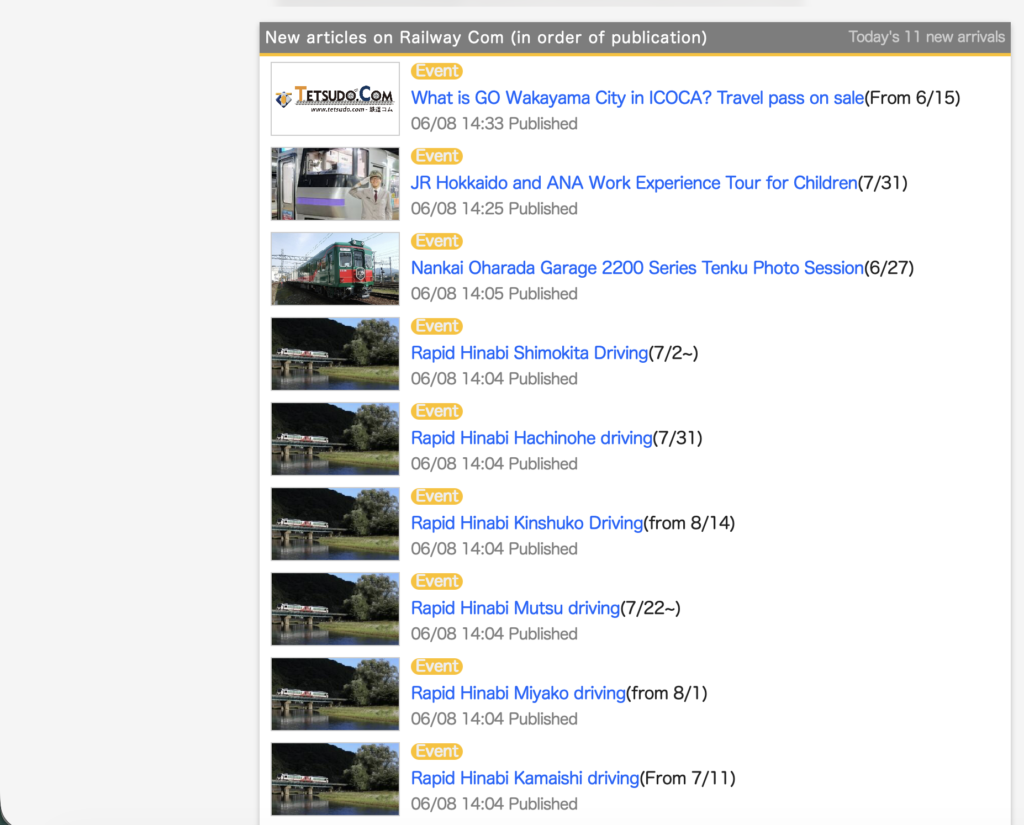
(As you can see, there already are couple of articles that mention that special trains and events are happening!)
Source: Screenshot from Tetsudo.com (鉄道コム). All rights and copyrights belong to Asahi Interactive, Inc.
Smart Spotting: Unleashing the Power of Apple Maps
Believe it or not, a powerful tracking tool is already sitting right in your pocket. Apple Maps has become surprisingly sophisticated when it comes to integrating temporary transit data in Japan.
When major seasonal trains—like the Ltd. Express Kamakura or Ltd. Express Jōban Kamakura—are officially scheduled to run, Apple Maps often pulls these irregular timetables directly into its route-finding engine on the day of operation. If you suspect a special train is running, try mapping a route between its major origin and destination stations on Apple Maps. You might just see a rare limited express pop up on your screen as a valid travel option, giving you a perfect real-time look at its exact station arrival times!
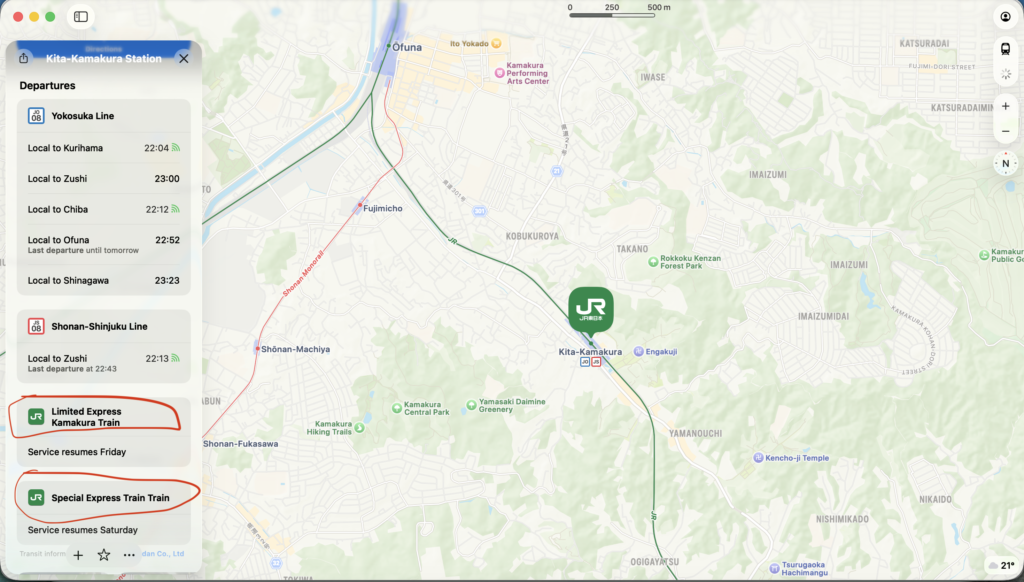
(The red circles indicate the special train section.) Source: Screenshot from Apple Maps. Maps and the Maps logo are trademarks of Apple Inc.
Going Digital: Translating Traditional Web Timetables
If you want to cross-reference your findings, you can dive into Traditional Web Timetables hosted by major railway operators like JR East, JR Central, or independent transit databases like Jorudan.
Much like Tetsudo.com, these portals allow you to select specific calendar dates to view everything running on a particular line. Simply apply your browser’s translation tool to these digital schedule grids. Look closely for footnotes or unique train names that differ from the standard “Local” or “Rapid” designations—these are your hidden seasonal gems.
The Ultimate Challenge: Are You Brave Enough for the Paper JTB Timetable?
For the purists who want the ultimate, unfiltered railfan experience, it’s time to go completely analog. Step into any Japanese bookstore or convenience store and pick up a physical copy of the legendary JTB Timetable (JTB時刻表).
This massive, brick-sized book contains the schedule of every single train operating in Japan for that month. It looks incredibly intimidating at first glance, but here is how you conquer it:
- Flip past the standard white pages and head straight toward the pink or shaded sections usually found near the front or center of the book.
- These specialized pages are dedicated entirely to “Seasonal Trains” (臨時列車).
- Line up the train names with the grid of numbers to find exact arrival and departure times for stations that regular express trains completely skip.
It takes patience, practice, and a sharp eye, but decoding a physical JTB timetable is a true badge of honor in the railway community.
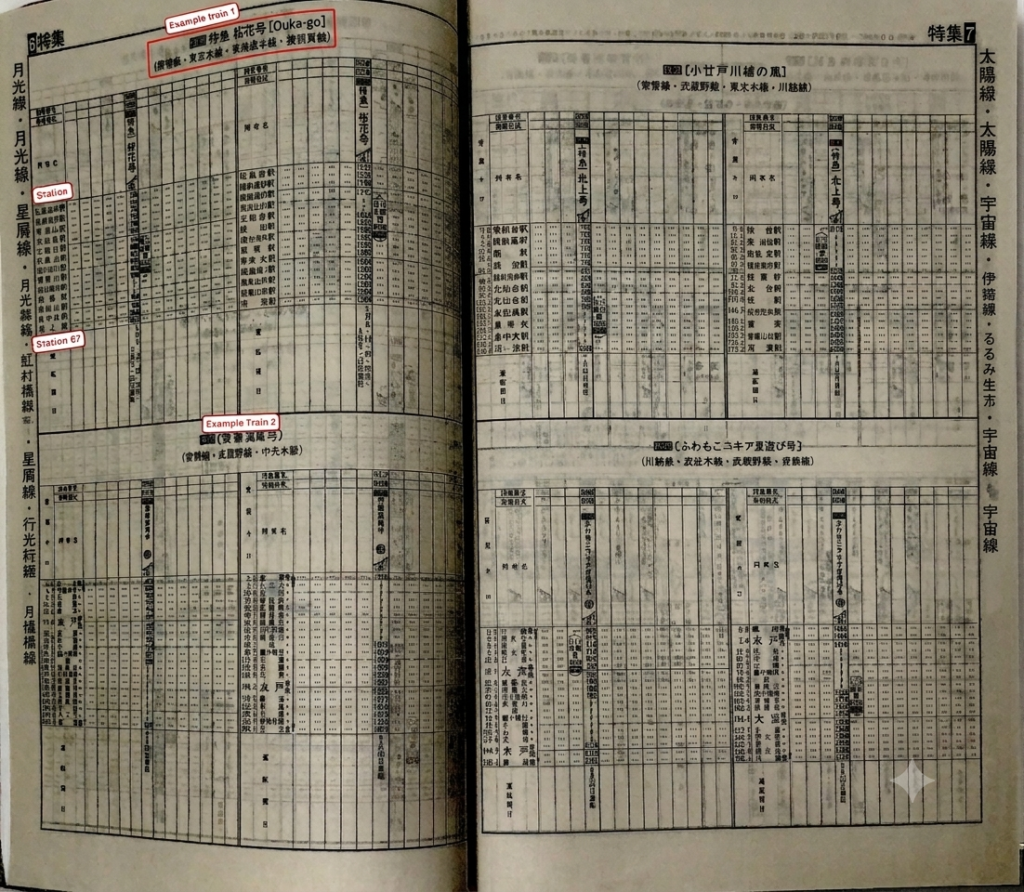
(This was generated by Gemini. Source: Instruction photo of a physical JTB Timetable (JTB時刻表), published by JTB Publishing Inc. All detailed schedule data is obscured for legal quotation and educational purposes.)
Summary: Your Train-Hunting Checklist
To make sure you never miss another epic rolling stock movement, keep this quick priority list in mind for your next trip:
| Tool | Difficulty | Best For |
|---|---|---|
| Tetsudo.com (Translated) | ⭐ (Easy) | Highly Recommended. Finding upcoming dates and specific train sets. |
| Apple Maps | ⭐ (Easy) | Quick, real-time route verification on the day of travel. |
| Web Timetables (Translated) | ⭐⭐ (Medium) | Double-checking specific platform numbers and station times. |
| JTB Paper Timetable | ⭐⭐⭐ (Hardcore) | Total mastery; finding obscure freight-line routes and rare charters. |
By leaning on Tetsudo.com as your primary guide and backing it up with smart mapping tools, you’ll always be in the right place at the right time to hear those iconic horns echo down the platform!